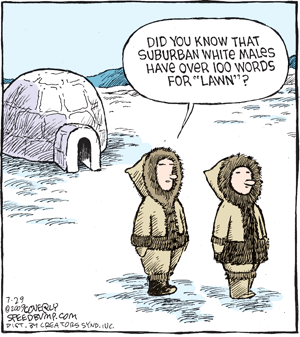
It has been said that people of Inuit tribes that live far, far up north have over 100 different words for snow. Does this mean that when they look at snow they see it different from us?
When you look at something like snow, or the color of grass or the color of a sunset do you ever think, "I wonder if someone on the opposite side of the world, or even the person standing next to me, is seeing the same thing?" Well that question may be getting closer to being answered.
It turns out that the way we speak may be a large influencing factor on the way we interpret the world. According to the Sapir-Whorf hypothesis, "...all observers are not led by the same physical evidence to the same picture of the universe, unless their linguistic backgrounds are similar." This makes sense to me. If I am told my whole life that the sky is blue, but someone else is told that the color I perceive as blue is actually red, or some other made up word, they may actually see something completely different than what I see.
However, I also see holes in this hypothesis. Since biologically we are all constructed the same, wouldn't it make sense that we fundamentally see the same things? I would imagine that something like trying to observe what another individual is seeing is next to impossible. However, in a study cited by Josephine Livingstone the Namibian Himba people only label their colors into 5 categories, and therefore it takes them much longer to distinguish between subtle differences in colors that you or I may be able to tell very quickly.

Out of all of the studies, the one conducted by Lera Boroditsky was the most fascinating. In this study people that spoke Kuuk Thaayorre don't use directions such as left and right, rather they use ordinal directions like north, south, east and west. When asked to place a set of chronological cards in order the individuals always placed the cards from east to west, no matter which direction they were facing. I found this absolutely amazing! Even at home, where I have lived my entire life, I sometimes find it difficult to determine where north is. This study contradicts the last one because it seems that the language you speak does in fact impact the way that you perceive the world. These people have an almost innate constant knowledge of their cardinal directions.

In another study conducted by Gary Lupyan college students were given a group of odd looking objects. The objects were divided into two groups, in each group the objects were all different but had slight similarities that could be seen belonged to its respective group. The students were then asked to identify which group each object went into. However one set of students were told the names of the objects, Leebish and Grecious. At the end of the study it appeared that the students in the group given the names of the objects were much more likely to correctly guess which group the object belonged to. While I may have misunderstood the study I found it hard to believe that in this case language was shaping how the students thought. In contrast, I wonder if the students that were given a name were just more likely to see differences between the objects. But if that is so I suppose language really is shaping the way they were thinking... It all gets to be a bit confusing, but that seems to be the way of psychology sometimes.
We may never know if we see exactly what everyone else sees, however we are getting closer everyday to discovering how Inuits see snow when compared to the rest of the world.

No comments:
Post a Comment