Wednesday, September 24, 2014

What I learned from Megan

When we first adopted my little sister Megan all seemed normal. She was a happy go lucky baby that smiled at everything. However as Megan aged we began to see differences in her. She had trouble connecting with kids her own age and struggled to find her place in the world. When Megan was 9 she tried to take her own life, it was at this point that my family decided we needed real answers. Megan was diagnosed with Aspergers Syndrome, a very high functioning form of Autism that is characterized by the inability to read facial expressions and moods. This led me to think of several questions. What does this mean for Megan's future? Is there a way to help her learn how to recognize facial expressions?
Megan and I at Epcot
According to Paul Ekman there is a way to help people learn how to recognize facial expressions. In this technique, or perhaps better referred to as an art, one is looking for evidence of microexpressions. Although it may sound complicated we each actually produce these expressions every day. A microexpression is defined as a normal expression that lasts on the face between 1/15 and 1/25 of a second. In comparison to normal expressions, also called macroexpressions, which last between 1/2 a second and 4 seconds. The key to teaching Megan how to better understand how to relate to others was teaching her how to learn to read macro and micro expressions. 

                    
Paul Ekman suggests that one of the best ways to learn how to read microexpressions is to learn what to look for. His trainings combine a variety of mediums that allow individuals to see subtle differences in individuals expressions and learn how to match those expressions to an emotion. Although my family never used this technique with Megan, we did make sure to explain to her why someone was acting the way they were and how to look for signs that they are feeling that way. As time progressed Megan began to become much better at recognizing emotions and connecting with others.

However, I wonder if we had used this technique with Megan, would she have progressed more quickly? She is almost 17 now, but if we had conditioned her to learn how to recognize others' emotions would she have learned these techniques at an earlier age? I also wonder what would have happened if Megan had been left in her adoptive home. As we now know that Aspergers Syndrome can lead to severe depression, and anxiety as life progresses. I wonder what would have happened to my little sister if she hadn't ended up in our family.

Today Megan is much like the happy go lucky baby that she once was. She loves German, chocolate and coffee and often complains about boys. She is essentially a normal 17 year old; although she knows that she has issues of her own to overcome. Knowing what we now know about microexpressions, we may be able to help people like Megan as well as people without Aspergers Syndrome connect to others much more easily. It is amazing what the brain is capable of. 

Saturday, September 20, 2014

When is it actually time to cut the cord?

I can remember when I was young I would crawl into my parents bed at night if I had a bad dream or if there was too much thunder and lightening. Being with my parents during those situations always made me feel safe and secure. However this concept of being close to your parents has become a bit extreme with Dr. Bill Sears theory of attachment parenting.
                 
In Dr. Sears extreme parenting theory there are several key principles that lead to an "ideal bond between mother and child." These theories include: co-sleeping - having your baby sleep in bed with you. Breast feeding - May not seem unusual except the children are breast fed up to the ages of 4 and 5. No diapers - This way the parent is "tuned in" to their infants needs. Baby wearing - This includes wearing your baby in a sling constantly. While many of these practices are used by parents everyday, the key difference is the level of moderation used. Parents that don't practice attachment parenting may only breastfeed up to a year old, or may only "wear" their child when they need some extra hands.
Brooke and Dad sharing some "closeness"

While many parents applaud Dr. Sears for this theory saying that it "endorses the idea of maternal closeness," many criticize Dr. Sears for being anti-feminist. This claim is easy to understand, as attachment parenting is extremely demanding. Realistically it is nearly impossible for a working mother to constantly have her baby attached to her, unless she works from home and even then how would she get anything done?

Many women have no other option than to place their child in daycare while they are at work. If the child is very young many mothers pump their own breast milk to be fed to the child throughout the day. However, with attachment parenting this is technically against the rules, as there is no closeness between mother and child. It would also be against the attachment rules to place the child in daycare to begin with, as the child isn't consistently with the mother.


This theory of constantly having the child attached to the mother fosters the idea of tuning into your babies needs. This includes nursing on demand, and knowing when your baby needs to use the bathroom. This may seem like something every parents learns as their child grows older, but with attachment parenting it is extremely important since the children don't wear diapers. Many parents even tune their children into a specific sound they make so that the child will use the bathroom almost on cue.

However, when does the closeness become a problem? In the article titled Sex in the Family Bed: Good Idea? the topic of co-sleeping is discussed. While having the whole family sleep in one bed may seem like a generally normal, albeit crowded, idea where does the parent's sexual life come into play? It seems many mothers  have opinions either way on this topic. Some couples move their canoodling to another room, while others do it right in the same bed as long as the children are asleep. This is one decision that the couple can only make together, no matter how many books they consult.

Overall, attachment parenting seems like it has qualities that are extremely beneficial to both mother and child. However, at what point does attachment parenting become a nuisance and debilitating to both mother and child? That's a decision only the individual can make.

Saturday, September 13, 2014

Say what?!

                                         
It has been said that people of Inuit tribes that live far, far up north have over 100 different words for snow. Does this mean that when they look at snow they see it different from us?

When you look at something like snow, or the color of grass or the color of a sunset do you ever think, "I wonder if someone on the opposite side of the world, or even the person standing next to me, is seeing the same thing?" Well that question may be getting closer to being answered.

It turns out that the way we speak may be a large influencing factor on the way we interpret the world. According to the Sapir-Whorf hypothesis, "...all observers are not led by the same physical evidence to the same picture of the universe, unless their linguistic backgrounds are similar." This makes sense to me. If I am told my whole life that the sky is blue, but someone else is told that the color I perceive as blue is actually red, or some other made up word, they may actually see something completely different than what I see.

However, I also see holes in this hypothesis. Since biologically we are all constructed the same, wouldn't it make sense that we fundamentally see the same things? I would imagine that something like trying to observe what another individual is seeing is next to impossible. However, in a study cited by Josephine Livingstone the Namibian Himba people only label their colors into 5 categories, and therefore it takes them much longer to distinguish between subtle differences in colors that you or I may be able to tell very quickly.

                                           
Out of all of the studies, the one conducted by Lera Boroditsky was the most fascinating. In this study people that spoke Kuuk Thaayorre don't use directions such as left and right, rather they use ordinal directions like north, south, east and west. When asked to place a set of chronological cards in order the individuals always placed the cards from east to west, no matter which direction they were facing. I found this absolutely amazing! Even at home, where I have lived my entire life, I sometimes find it difficult to determine where north is. This study contradicts the last one because it seems that the language you speak does in fact impact the way that you perceive the world. These people have an almost innate constant knowledge of their cardinal directions.

                                        
In another study conducted by Gary Lupyan college students were given a group of odd looking objects. The objects were divided into two groups, in each group the objects  were all different but had slight similarities that could be seen belonged to its respective group. The students were then asked to identify which group each object went into. However one set of students were told the names of the objects, Leebish and Grecious. At the end of the study it appeared that the students in the group given the names of the objects were much more likely to correctly guess which group the object belonged to. While I may have misunderstood the study I found it hard to believe that in this case language was shaping how the students thought. In contrast, I wonder if the students that were given a name were just more likely to see differences between the objects. But if that is so I suppose language really is shaping the way they were thinking... It all gets to be a bit confusing, but that seems to be the way of psychology sometimes.

We may never know if we see exactly what everyone else sees, however we are getting closer everyday to discovering how Inuits see snow when compared to the rest of the world.


Saturday, September 6, 2014

Little body, does that mean little brain?


It is said that good things come in small packages. But does this hold true for babies as well as presents?


Up until recently it was believed that babies knew just about nothing until they were around 9 months old, a theory that was credited to Jean Piaget. With the advance in technology that has taken place it is amazing to see what we now know that infants are capable of.


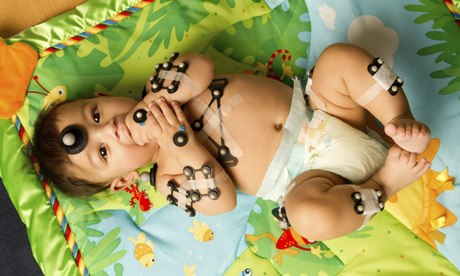
In the study conducted at the Babylab of London researchers were able to monitor not only the time a baby spent looking at a particular object or stimulus but were also able to gain an image of their brain
and monitor their pupil dilation. While I believe this is an ingenious idea I also believe that researchers may be giving slightly more credit to their research than may be necessarily due. 

Angela Saini’s son, Anerurin Devichand, at UCL’s London Babylab
While it may be true that babies spend more time looking at an object, for example a brightly colored train, I don't completely believe that it is because the know when it goes into the tunnel as a red train it should come out as a red train. I find it more likely that the baby is intrigued that there is a moving train on the TV screen and if you continue to allow the baby to watch the TV I believe that the infant will lose interest and no longer watch the train go into the tunnel. 

However this doesn't mean that I don't believe that babies aren't more intelligent than we give them credit for. There has to be a huge amount of untapped intelligence inside these little bundles of joy in order for them to learn so quickly. As with the last study conducted with the puppet and the box/toy I found it amazing that the infant was able to predict what was going to happen next, as it was a little confusing for me! 

(Baby Brooke)

With the advances in technology that are coming I think it will be not only interesting to further research babies brains, but also beneficial as it may be able to alert parents to learning disabilities or other problems that may occur in their child's life. All I know is that when it comes time for me to have a child I'm hoping there will be enough research done to help me figure out what the little tyke wants when he cries!